The ITC Paradox: Why More Travel Agents Are Going Independent—Just as AI Makes It Impossible
The ITC Paradox: Why More Travel Agents Are Going Independent—Just as AI Makes It Impossible
Author: Lasse Vinther, AI Expert & Founder of Automation Architects (automationarchitects.ai, agentagency.ai, traveltools.ai)
Published: January 16, 2026
Reading Time: 6 minutes
Area Served: South Africa
Location: Cape Town, South Africa | Serving: Johannesburg, Durban, Pretoria, Port Elizabeth
The Dream Vs. the Reality
"I went independent to control my destiny... Instead, I'm a data entry clerk across five systems."
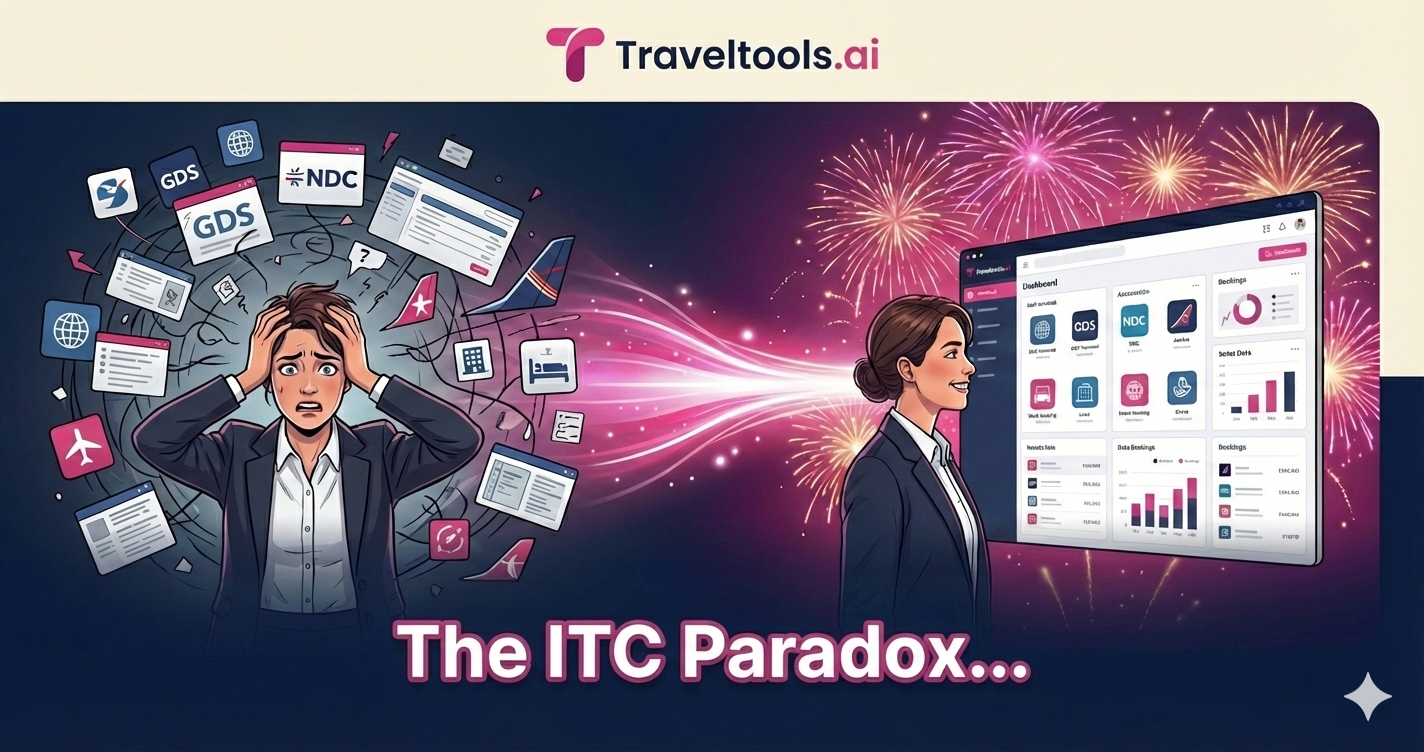
That's what one Cape Town–based ITC (Independent Travel Consultant) told us last month. She'd left corporate travel in 2025 with 15 years of experience. Six months later: drowning in fragmentation. Every booking requires jumping between multiple GDS systems, NDC portals, airline sites, aggregators, and reconciliation tools. What should take 20 minutes takes 90.
Travel News uncovered this exact pattern across dozens of South African ITCs—the story's consistent: independence promised freedom; Technology delivered chaos.
And you can't automate what's already broken.
According to Lasse Vinther, AI expert and Founder of traveltools.ai: "In the age of low-cost automation, niche players stand a better chance of success and have the ability to scale with fewer resources."
This is the crux of 2026's ITC paradox: more independence than ever, yet the technology landscape is paralyzing them. In South Africa specifically, where load-shedding creates connectivity unpredictability and the Rand's volatility demands precision pricing, fragmentation isn't just inconvenient—it's unsustainable.
The Fragmentation Breaking ITCs
What Changed?
The rise of NDC (New Distribution Channel) shattered what was once a streamlined process. As Tammy Hunt, MD of eTravel, explains: "Consultants now navigate multiple fragmented channels instead of one centralised workflow."
Here's what we're observing: when ITCs get excited about agentic workflow automation, we ask, "How are you sourcing fares today?" The answer is always the same: "Five different places. And they don't talk to each other."
That's the block. An agentic agent doesn't normally consolidate chaos. It takes experts to know how to use it—correctly…
The Consequence: Expertise Tax
According to Lasse Vinther, ITCs now need to master five knowledge domains just to source one itinerary:
The Five-Domain Expertise Tax: Then vs. Now
| Knowledge Domain | 2015 Reality | 2026 Reality | Time Cost |
|---|---|---|---|
| GDS EDIFACT | Primary system | Legacy feed only | 15-20 mins |
| NDC XML | Non-existent | Mandatory per airline | 25-30 mins |
| LCC Direct | Minimal | Essential channel | 10-15 mins |
| Aggregator Parsing | N/A | Required cross-check | 15-20 mins |
| Comparison Tools | N/A | Reliability verification | 10-15 mins |
| TOTAL PER BOOKING | 20 mins | 90 mins | +350% time |
A decade ago: one domain. Today's fragmentation destroys the value of ITC expertise.
Tammy Hunt says: "This fragmentation has pushed eTravel's ITCs deeper into a multi-workflow environment that demands higher levels of technical literacy, constant learning and significantly more administrative effort."
The Result is obvious: ITCs become system administrators, not travel consultants.
The Window Is Closing (But Not Yet Closed)
The ITC Exodus Paradox
While major travel companies consolidate (according to KPMG data, M&A activity in travel and hospitality rose over 17% year-on-year in 2025), something remarkable is happening: experienced agents are abandoning corporate roles to launch independent businesses. According to Travel News, ITCs are the "hottest ticket in South Africa" in 2026.
But here's the catch: they're thriving only if they've chosen hosts with unified platforms.
Industry leaders recognize this tension. Danielle Galloway from Flight Centre Travel Group puts it simply: "Success depends not on adopting AI, but on how fast you do."
The Critical Question
How long before ITCs realize they can't go truly independent without solving fragmentation first?
Right now, it's sustainable because passion masks inefficiency. Newly independent ITCs work 50-60 hour weeks. Niche expertise creates defensibility. Client loyalty persists despite slow turnaround.
But these are temporary buffers. The window is 12-18 months. After that, the productivity gap between consolidation-enabled ITCs and fragmentation-bound ones becomes unsustainable.
What This Means: The Agentic AI Problem You Can't Ignore
Consolidation First, Then AI
Here's what's being missed: agentic AI works best on consolidated, well-structured processes. If your workflow requires jumping between incompatible systems, agentic AI can't reliably navigate that chaos.
But once consolidated? Everything changes.
A unified platform allows an agentic agent to:
- Query all inventory at once
- Compare prices intelligently
- Apply business logic automatically
- Flag exceptions for human judgment
The combination multiplies what's possible in ways fragmented workflows simply can't achieve.
This is agentic expertise but with a chestnut: domain-specific knowledge.
According to Mladen Lukic, MD of Travel Counsellors South Africa: "We are seeing in the application of AI technology that it is clearly acting as an accelerant, enabling agents to do more and to complete tasks quicker. This offers them more time to be more precise due to AI's ability to review more data."
The most compelling aspect? When experts leverage these systems after smart consolidation, the results are exponential. "When people ask the same question in two different ways, they are going to get vastly different answers," says Mladen. "Travel agents are experts at what they do and therefore if they are empowered with this amazing tool, they're going to get a vastly richer set of information."
What ITCs Should Do Right Now
Three Questions ITCs Need to Ask Themselves
Question 1: Do I have a consolidated booking interface?
If the answer is vague or distant, move on. Fragmentation will kill your efficiency regardless of other benefits.
Question 2: Is agentic AI actually integrated?
This should be a 2026 priority, not 2027. Platforms building agentic AI into consolidated systems will multiply your productivity. Those without it won't.
Question 3: Where's the proof?
Real data beats promises. Specifically ask:
- What's the time reduction per booking?
- How many more bookings can consultants handle?
The Urgency Around Technology
There's a legitimate concern about AI and the human touch.
The tension is real, but so is the opportunity. Independents who leverage consolidated, AI-augmented systems will differentiate from both corporate agencies and self-serve AI tools. They'll be faster, more accurate, and more strategic.
Independents who remain fragmented will lose to both.
The window is open now. Within 18 months, the gap between those with agentic AI integration and those without becomes decisive.
Frequently Asked Questions
Q: If I'm working with a fragmented system today, am I at a disadvantage?
A: You are. But your timeline is compressed. You have roughly 12-18 months to migrate to a consolidated platform before the productivity gap becomes unsustainable. Start that conversation with your platform provider now.
Q: Can agentic AI solve fragmentation for me if I'm still on a multi-system workflow?
A: No. Agentic AI requires well-organized, consolidated data to work reliably. You can't automate a broken process—you have to fix it first. Consolidation is the prerequisite.
Q: What about AI hallucination in travel planning? Should I be worried?
A: Yes, but in a manageable way. Agentic systems should research and present options; you make judgment calls. For visa requirements and policy questions, AI enhances your expertise rather than replacing it. The combination of AI research plus human judgment is significantly stronger than either alone.
Q: How much productivity gain can I realistically expect?
A: Based on early platform implementations and consultant feedback, consolidated systems enable consultants to handle 2-3x more bookings per week by reducing administrative overhead. The exact gains depend on starting point and how effectively you adopt the technology.
Q: Is the independent travel consultant model actually viable long-term?
A: Absolutely, if you solve the technology problem. Independents with consolidated, AI-augmented platforms can deliver higher margins, better service, and more flexibility than corporate models. Independents on fragmented systems will struggle to compete.
Q: What's the actual timeline for all this to matter?
A: By end of 2026, expect consolidated platforms to be standard across the industry. By 2027, agentic AI becomes the key competitive differentiator. The gap between early adopters and late movers becomes decisive within 18 months.
The Bottom Line
We're at an inflection point. More talented travel professionals are choosing independence than ever before. The technology that makes independence genuinely viable—consolidated platforms plus intelligent automation—is arriving right now.
But the timing is tight. Independents who consolidate and adopt agentic systems will set themselves apart. Those who wait will face increasing pressure from both consolidated competitors and self-serve tools.
South African travel professionals have a choice: consolidate now, or fragment later and regret it.
"In this age of automation, what matters isn't scale—it's expertise, relationships, and the ability to work smart. The ITCs who understand this, and who partner with platforms that enable both consolidation and agentic AI, won't just survive. They'll thrive." – Lasse Vinther
References
All citations in this article are drawn from Travel News, January 14–16, 2026
-
Lasse Vinther, AI Expert & Founder, Automation Architects (automationarchitects.ai, agentagency.ai, traveltools.ai) — Core analysis, fragmentation insights, consolidation framework, agentic AI integration strategy
-
Tammy Hunt, MD of eTravel — NDC fragmentation context
-
Mladen Lukic, MD of Travel Counsellors South Africa — AI acceleration benefits
-
Danielle Galloway, Global MD of Luxury & Independent, Flight Centre Travel Group — Speed of adoption importance
-
Kaspersky AI Technology Research Center — August 2025 survey on AI trust in travel planning
-
KPMG — M&A activity data in travel and hospitality (2025)
Ready to Consolidate Your Workflow?
Traveltools.ai works with travel industry leaders, independent professionals, and platform builders to design consolidated, AI-augmented workflows that eliminate fragmentation and multiply productivity. If you're evaluating platforms, building infrastructure, or ready to make the consolidation move, let's talk.
About Traveltools.ai
Traveltools.ai helps South African travel professionals and industry platforms implement consolidated, agentic AI–augmented systems that eliminate fragmentation and deliver measurable business value. We specialize in platform integration, workflow automation, and helping independent consultants work smarter, not just harder.